
1. The Definition
Anxiety could be a natural response when an individual faces a threat or danger.
It’s common and normal that children feel anxious about different things during their development. Researches have claimed that controllable anxiety can be sometimes beneficial as it helps the individual to better manage the events, however high level of anxiety has a negative impact on an individual’s life (Herrero, Sandi, & Venero, 2006).
Anxiety becomes a disorder when it refers to mental and physiological fear that is disproportionate to a given situation or event. This fear could be caused by an actual situation or future unwanted event. Anxiety and fear are closely related, but not identical. Scholars differentiate between fear and anxiety based on the fact that fear is an adaptive response to realistic threats, whereas anxiety is an unreasonable or excessive reaction to current or future perceived threats (Evans, Foa, Gur, Hendin, O’Brien, Seligman, & Walsh 2005).
Anxiety becomes problematic when it interferes in the daily activities and life of the individual, when it causes high levels of distress or when its symptoms become extreme and disabling over a period of a month or more (Evans, Foa, Gur, Hendin, O’Brien, Seligman, & Walsh, 2005).

source: https://www.who.int/mental_health/advocacy/WB_event_2016/en/
According to the World Health Organization, the most common mental disorders are anxiety and depressive disorders. Globally, it’s estimated that 4.4% of the global population suffer from depression, while 3.6% suffer from anxiety disorder (WHO, 2017).
2. Causes and Types
Anxiety disorders can be caused by individual’s genetics, biochemistry, environment, history, or psychological profile. They can be perceived and defined based on causality: (American Psychiatric Association, 2013).
- Internal factors
Anxiety can be caused by internal factors. Individuals can be affected by their own pathological conditions. For example, generalized anxiety disorder, social anxiety disorder, obsessive compulsive disorder or post-traumatic stress disorder. - Environmental variables
Anxiety can be caused by environmental factors such as home, neighborhood or school. Individuals can be affected by abusive, hostile, disorganized environment. - Combination of both
This group consists of individuals, who do not function well in situations where their individual differences and minor vulnerabilities are poorly accommodated or are responded to hostilely.
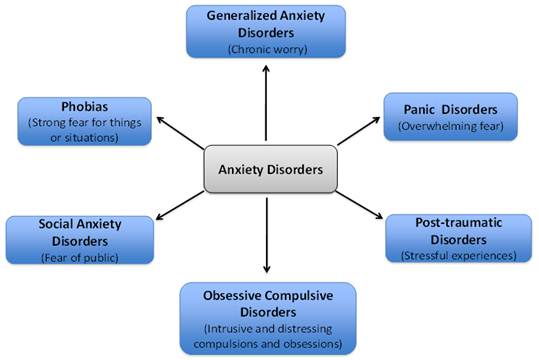
source: article.sciencepublishinggroup.com/html/10.11648.j.ijcems.20160201.12.html
Below are some examples of the most common anxiety disorders as listed in the listed in the Diagnostic and Statistical Manual of Mental Disorders (American Psychiatric Association, 2013).
- Panic disorder
This type of anxiety involves the occurrence of spontaneous panic attacks that can happen for no obvious reason. Panic attack symptoms usually include fast heart beats, shortness of breath, dizziness or numbness. - Social anxiety disorder
This type of anxiety results from extreme fear in social situations with unfamiliar people. This anxiety could easily be sparked by social situations or speaking in front of other people. - Separation anxiety disorder
This type of anxiety results from extreme fear about being separated from home or close friends and family members, to whom they are attached. - Obsessive compulsive disorder (OCD)
This type of anxiety takes the form of obsessions (excessively preoccupying thoughts) and compulsions (repetitive actions to try to relieve anxiety). - Post traumatic stress disorder (PTSD)
This type of anxiety results from a traumatic past experience. PTSD’s symptoms usually include flashbacks, nightmares, fear, and avoidance of the event that caused the anxiety. - Generalized anxiety disorder (GAD)
This type of anxiety involves a pattern of excessive constant worry for a period of 6 months. These worries become difficult to control to the extent that they become a burden, making the individual feel overwhelmed or out of control. Symptoms related to this type of anxiety may include headaches, stomachaches, muscle tension, or tiredness. - Specific phobia
This type of anxiety is resulted from intense fears of specific objects or situations that are not known for being dangerous, such as heights, dogs, or airplanes. Phobias usually cause people to avoid the things they fear.
3. The Symptoms
Anxiety disorders can affect an individual’s day-to-day life, especially when it comes to concentrating, sleeping, and eating. The high level of anxiety experienced by individual can manifest itself in a number of different ways. Some symptoms are listed below:

source: https://www.pinterest.com/pin/640637115715446938/
1- Extreme and constant worry for a period of time
2- Doubt and questioning
3- Crying, whining, and inability to control emotions
4- Stubbornness, and anger
5- Trouble sleeping at night or sleepiness during the day
6- Restlessness or fatigue during waking hours
7- Decreased appetite or other changes in eating habits
8- Trouble concentrating
9- Poor school performance
10- Unwillingness to participate in family and school activities
11- Loss of interest in previously enjoyed activities
12- Obsession about appearance or weight
13- Physical symptoms include rapid heartbeat; sweating; trembling; muscle aches; dry mouth; headache ; stomach distress; diarrhea; constipation ; frequent urination; bed-wetting; stuttering ; hot flashes or chills; throat lumps; and fatigue
Here is a video showing a kid describing her anxiety disorder symptoms:
- It’s common for kids and adolescences to avoid talking with their closed ones about those feelings to avoid being misunderstood and judged. This kind of reaction leads to the kids feeling lonely.
- According to the World Health Organization, a large number of studies provide strong evidence that anxiety disorders are more common in girls and women when compared to boys and men. But although females are more likely to have or express anxiety, it’s very important to know that both genders can actually experience anxiety disorders.
- Shyness is common during childhood and adolescences, that’s why it should be known that shyness alone is not an indication of anxiety disorder. It’s only when it interrupts the normal day-to-day activities or occurs with other symptoms that one can link it to anxiety disorder.
- Anxiety and depression have very similar symptoms. As many as 50 percent of children with anxiety also suffer from depression.
4. Impact of anxiety disorders on learning
The graph and the video illustrate the amygdala, hippocampus and prefrontal cortex in the brain and how they are related to anxiety:

source: https://developingchild.harvard.edu/science/deep-dives/neglect/
Studies have linked anxiety and fear to specific parts of the brain, the amygdala and the hippocampus. The amygdala is responsible of processing fear emotions while the hippocampus plays an important role in how the body responds to the fear or threat. Stress triggers the activation of stress hormones, which was suggested to impair the growth and performance of both the amygdala and the hippocampus. It was also found that stress hormones can have negative impact on the development of the prefrontal cortex, which is essential for the learning process (National Scientific Council on the Developing Child, 2010).
Anxiety disorders affects many aspects of the learning process, few of the most important implications are concentration, memory, social interaction and health:
- Concentration
High level of anxiety affects effective learning, as it impacts the grasping and processing of information, since most of the attention of the working memory is consumed for managing the anxiety. People who suffer from anxiety tend to get distracted by wasting most of their energy and attention for dealing with the anxiety, which results in poor working memory that affects their learning negatively (Heimberg, Mueller, Holt, Hope, & Liebowitz, 1993).
Also the psychological control of anxiety can cause impairment to the brain activity, which can negatively impact the attention and concentration of a person. (Goleman, 2004). The Learning process is a cognitive activity, which it relays on encoding, storing and retrieval of information. These processes can be highly disturbed in anxious people , since they suffer from attention and concentration loss (Ansari & Derakshan, 2010). - Memory
Working memory is described as short term storage that can keeps and operates incoming ideas and combines it with other information storage in long term memory in order to use it in new conditions. This procedure is responsible for usual activities such as learning, reasoning, and reading skills (Baddeley, 1988).
Working memory has a limited capacity and anxiety decreases the amount of processing capability available for working memory tasks (Eysenck, 1992). Anxiety can trigger memory disturbance by preoccupation, creating unrelated thoughts and reducing awareness and attention. Resulting in memory distraction, which influence the learning process negatively (Eysenck, Derakshan, Santos, & Calvo, 2007).
Studies conducted about brain transmitters show that individuals’ relief level can impact information transmission and storage in the brain. It suggested that stress raises dopamine activity in the prefrontal cortex, which is linked to disruptions in the brain’s temporary memory (Thanos, Katana, Ashby, Michaelides, Gardner, & Heidbreder 1999). - Social Interaction
Anxiety causes social withdrawal and avoidance, as the person who suffer from anxiety tend to focus on potential or illusion threat, where they react to a social situation that are neutral as a threat. Therefore, they become less sociable and avoid peer interaction. As a result they are perceived by peers as unfriendly people.
High anxious students avoid tasks that require communication or that involve potential peer or teacher evaluation. They consequently miss the benefit of interactive learning experiences. - Health
Anxiety directly affects the physical performance, symptoms such as sleep deprivation, fatigue, nausea, headaches, unexplained illness occurs . Children with anxiety have higher heart rate, higher blood pressure, higher skin tension and higher stress hormones. Since these symptoms are real, children tend to miss a lot of school days, which diminish their learning opportunities (Gamble, n.d.).
5. How to manage students with anxiety
Teachers should be knowledgeable about anxiety disorders, how to detect anxious students and how those disorders impact students learning process. They should be able to help students with anxiety to better perform academically and socially:
- Comfort and emotional support:
1. Permit student to use calming techniques or bring calming objects that will make them feel safe (teddy bear or a family picture).
2. Arrange classroom seating that is most comfortable for students (near the door, near the teacher or a friend).
3. Give a break pass, where the students can take a short walk, go to bathroom or take a drink.
4. Assign the student a certain friend to accompany them during lunch time and recess
5.Design a makeup plan for absences or illness
6. Excuse missed assignments or provide extend the time frame for make ups (Morin)
- Teaching techniques and classroom environment
1. Give prior notice and extra time to students before any transition and review transition in private or low-stress environment. (change in routine)
2. Make a list with classroom expectations and consequences (oral and written).
3. Break down assignment into smaller pieces.
4. Monitor student understanding and emotional state.
5. Provide a signal for students before they are call on to answer a question (Morin).
- Classwork and Testing
1. Exempt the student from presenting or reading aloud in front of the class.
2. Allow the student to present to the teacher privately.
3. Give extended time on test or separate test-taking space.
4. No pop quizzes.
5. Reduce amount of homework.
6. Provide notes for students to preview (Morin).
References:
American Psychiatric Association. (2013). Diagnostic and statistical manual of mental disorders (5th ed.). Washington, DC:Author.
Ansari, T. L., &Derakshan, N. (2010). Anxiety Impairs Inhibitory Control But Not Volitional Action Control. Cognition and Emotion, 24(2), 241-254.
Baddeley, A. (1988). Cognitive Psychology and Human Memory.Trends in Neurosciences, 11(4), 176-181.
Depression and Other Common Mental Disorders: Global Health Estimates. Geneva:World Health Organization; 2017.
Evans, D. L., Foa, E. B., Gur, R. E., Hendin, H., O’Brien, C. P., Seligman, M. E. P., & Walsh, T. (Eds.). (2005). Treating and preventing adolescent mental health disorders: What we know and what we don’t know: A research agenda for improving the mental health of our youth. New York, NY, US: Oxford University Press.
Eysenck, M. W. (1992). Anxiety: The Cognitive Perspective: Psychology Press.
Eysenck, M. W., Derakshan, N., Santos, R., &Calvo, M. G. (2007). Anxiety and Cognitive Performance: Attentional Control Theory. Emotion, 7(2), 336
Gamble, A. (n.d.). Anxiety and Education Impact, Recognition & Management Strategies, Centre for Emotional Health . Retrieved from Macquarie University: http://www.cheri.com.au/CHERIAnxandEd_final.pdf.pdf
Goleman, D. (2004). Leadership That Gets Results. Harvard Business Review.
Heimberg, R. G., Mueller, G. P., Holt, C. S., Hope, D. A., &Liebowitz, M. R. (1993). Assessment of Anxiety In Social Interaction And Being Observed By Others: The Social Interaction Anxiety Scale and the Social Phobia Scale. Behavior Therapy, 23(1), 53-73.
Herrero, A. I., Sandi, C., &Venero, C. (2006). Individual differences in anxiety trait are related to spatial learning abilities and hippocampal expression of mineralocorticoid receptors. Neurobiology of learning and memory, 86(2), 150-159.
Morin, A. At a Glance: Classroom Accommodations for Anxiety. Retrieved from http://www.understood.org/en/school-learning/partnering-with-childs-schools/instructional-strategies/at-a-glace-classroom-accommodations-for-anxiety
National Scientific Council on the Developing Child (2010). Persistent Fear and Anxiety Can Affect Young Children’s Learning and Development: Working paper No. 9. http://www.developingchild.net.
Thanos, P. K., Katana, J. M., Ashby, C. R., Michaelides, M., Gardner, E. L., Heidbreder, C. A., et al. (1999). The selective dopamine D3 receptor antagonist SB-277011-A attenuates ethanol consumption in ethanol preferring (P) and non-preferring (NP) rats. Pharmacology, Biochemistry, and Behavior, 81(1), 190–197
 EDUC-Marwa Lotfi